Pickleball Court Dimensions and Slab Specs for Central Texas
Quick answer: a pickleball court is 20 × 44 feet with a 7-foot kitchen on each side of the net. For one backyard court, plan a 30 × 60 foot pad at minimum and 34 × 64 if you have the room. The slab under it is usually 4–5 inches of 3,000–3,500 psi concrete, sloped about 1 inch per 10 feet in one plane. In Central Texas clay, the reinforcement choice matters as much as the size.
Most pickleball dimension guides stop at the lines. If you are actually building a court, the lines are the easy part. The pad size decides how much yard you give up, and the slab decides whether your court is still smooth in five years. This guide covers both, with the numbers our concrete crew works from in Bell County and the sources behind them.
Court dimensions (the lines)
| Item | Dimension |
|---|---|
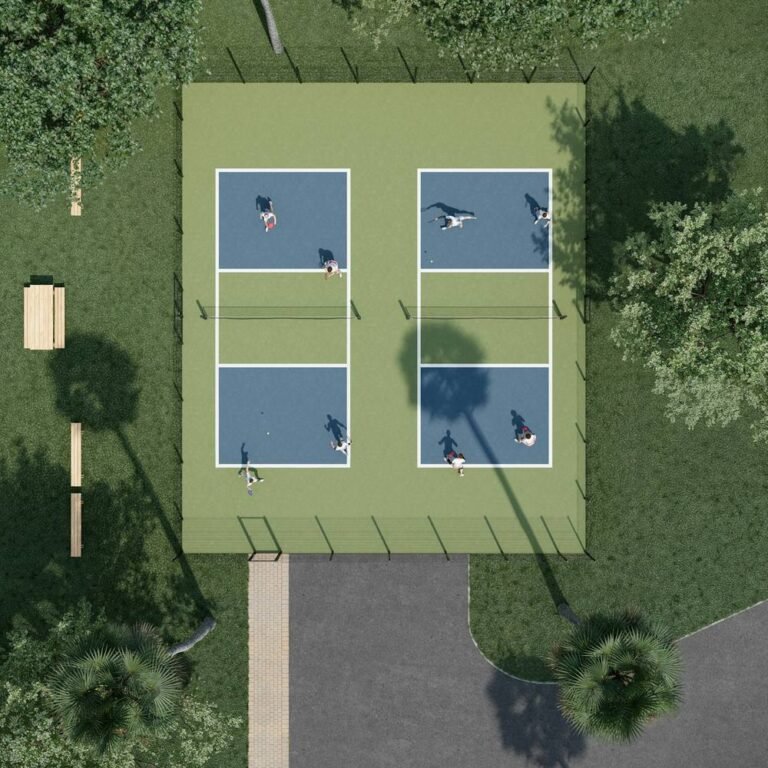
| Playing court (singles and doubles) | 20 × 44 ft |
| Non-volley zone (kitchen), each side | 7 ft from the net |
| Service courts, each | 10 × 15 ft |
| Line width | 2 in, one color that contrasts with the court |
| Net height | 36 in at sidelines, 34 in at center |
Source: USA Pickleball Official Rulebook. Lines are part of the area they bound, so measure to the outside edge of each line.
Pad sizes: how much concrete you actually need
The pad is the whole surfaced slab, court plus run-off. More room behind the baselines matters more than room at the sides, because that is where players back up for lobs.
| Layout | Pad | Area | Good for |
|---|---|---|---|
| Lines only | 20 × 44 ft | 880 sq ft | Driveway and side-yard conversions, no run-off |
| Tight fit | 30 × 50 ft | 1,500 sq ft | Casual play, short on depth |
| Standard single court | 30 × 60 ft | 1,800 sq ft | Most backyard courts; fits half-court basketball |
| Recommended single court | 34 × 64 ft | 2,176 sq ft | Comfortable or tournament-style play |
| Two courts side by side | about 50–64 × 60–64 ft | 3,000+ sq ft | HOAs, churches, serious families |
| Tennis footprint | 60 × 120 ft | 7,200 sq ft | Up to four pickleball courts |
Pad sizes as commonly published by Texas court builders, including Build My Courts. Your yard, setbacks, and fence layout set the final size.
Concrete volume for common pads
Here is the math for ordering concrete (length × width × thickness in feet, divided by 27). Add 5–10 percent for waste, edges, and uneven subgrade.
| Pad | 4-inch slab | 5-inch slab |
|---|---|---|
| 30 × 60 ft | about 22.2 cu yd | about 27.8 cu yd |
| 34 × 64 ft | about 26.9 cu yd | about 33.6 cu yd |
| 60 × 120 ft | about 88.9 cu yd | about 111.1 cu yd |
Slope, orientation, and drainage
A court has to shed water, but players should never feel the slope. Court specifications call for about 1 inch of fall per 10 feet (0.83 percent, or 1:120) in a single true plane, preferably from side to side (Quality Court, Post-Tensioned Concrete Court Specifications; Pinnacle Sports Group cites about 1 percent). On a 34-foot-wide pad sloped side to side, that is roughly 3.4 inches of total fall.
- Never slope toward or away from the net, and never crown the court to the center or the sides.
- Raise the court. The same spec puts the finished subgrade 4–6 inches above the surrounding ground, with the yard graded away so water never runs across the court.
- Orient north–south where the lot allows, so the low Texas sun is not in a player’s eyes at either end.
- Check for birdbaths. Low spots that hold water after a rain are the most common punch-list item on a new court, and they are much easier to prevent with careful screeding than to patch later.
Slab specs: thickness, strength, and finish
| Spec | Typical requirement | Why it matters |
|---|---|---|
| Thickness | 4–5 in (5 in in a PT court spec) | Stiffness and room for reinforcement |
| Strength | 3,000 psi min.; 3,500 psi recommended | Durability and crack resistance |
| Mix | No fly ash or slag; no curing compounds | Both can keep acrylic coatings from bonding |
| Finish | Medium broom, not a slick steel trowel | Gives the acrylic surface something to grip |
| Vapor barrier | Under the slab, over the base | Limits moisture pushing up and blistering the coating |
| Cure before coating | About 28 days | Acrylic will not bond well to green concrete |
Sources: Quality Court, Post-Tensioned Concrete Court Specifications; Quality Court, Tennis/Pickleball Court Construction FAQ; Champion Sport Surfaces.
Post-tensioned vs. rebar vs. wire mesh
This is the decision that drives both price and long-term performance.
| Reinforcement | How it works | Trade-off |
|---|---|---|
| Post-tensioned (PT) | Steel cables run both ways through the slab and are tensioned after the pour, putting the whole slab in compression | Resists cracking, no saw-cut joints, preferred under acrylic and for multi-court slabs. Roughly twice the cost of rebar (Pinnacle Sports Group). Engineered design. |
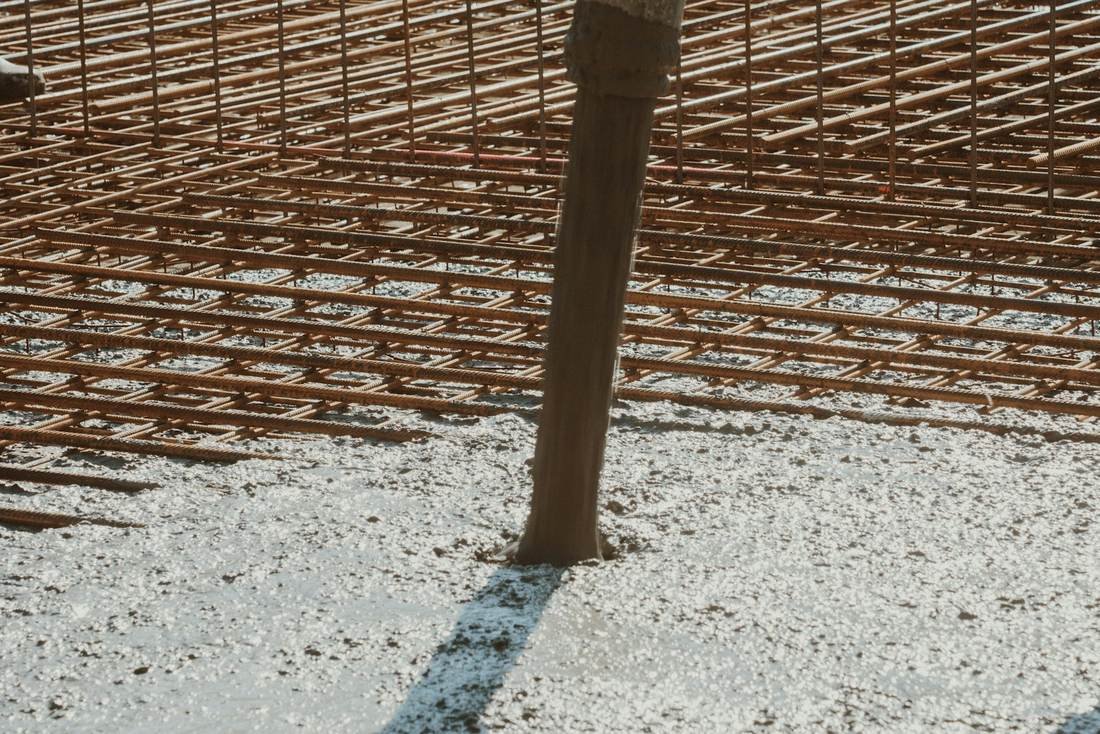
| Rebar grid | Steel bars on chairs hold the slab together after it cracks | Lower cost and familiar. Needs control joints, and hairline cracks can show through the surface over time. |
| Wire mesh / fiber | Light reinforcement for shrinkage cracking | Cheapest. Not what we recommend for a court on Central Texas clay. |
Why Central Texas soil changes the spec
Temple and eastern Bell County sit on the Blackland Prairie, where Houston Black clay is the most common soil (Texas State Historical Association). The Texas Water Development Board calls it a classic vertisol that shrinks and swells markedly with moisture. Killeen and western Bell County are on the Grand Prairie, with shallower, limy and sometimes rocky soils, plus pockets of the same clay.
On a moving clay subgrade, a slab with joints every 10–15 feet will usually show those joints and some cracks through the acrylic within a few seasons. That is why court builders in Texas lean toward post-tensioning on clay, and why base prep and drainage get as much attention as the concrete itself. On rocky western-county lots, a reinforced rebar slab on a well-prepared base is more often a reasonable way to save money. For larger HOA or school courts, a geotechnical report and an engineered slab design are worth the cost.
Want the local details? See pickleball courts in Temple (blackland clay) and Killeen and Harker Heights (limestone and hillside lots).
Get a slab spec for your yard
We measure the site, check soil and drainage, and give you a written quote that lists slab thickness, strength, and reinforcement line by line.
Bell County Concrete Pros · 3671 Wild Buck Run, Temple, TX 76502 · Mon–Sat 8am–6pmFrequently asked questions
What are the dimensions of a pickleball court?
The playing court is 20 feet wide by 44 feet long for both singles and doubles, with a 7-foot non-volley zone (the kitchen) on each side of the net. Lines are 2 inches wide. The net is 36 inches high at the sidelines and 34 inches at the center.
How big should the concrete pad be for one pickleball court?
Builders treat 30 x 60 feet (1,800 square feet) as the practical minimum for one court and 34 x 64 feet (2,176 square feet) as the comfortable or tournament size. A 20 x 44 foot slab is only the lines with no run-off room.
How thick should a pickleball court slab be?
Court slabs are typically 4 to 5 inches thick. One post-tensioned court specification calls for 5 inches of 3,500 psi concrete with no fly ash, because fly ash can interfere with how the acrylic surface bonds.
What slope does a pickleball court need?
About 1 inch of fall per 10 feet (roughly 0.83 to 1 percent), in one flat plane, preferably side to side. A court should never slope toward or away from the net or toward the centerline.
Is post-tensioned concrete worth it in Central Texas?
On expansive clay, often yes. Post-tensioned slabs cost roughly twice as much as rebar slabs but resist cracking and do not need saw-cut control joints, which can telegraph through acrylic. On stable, rocky ground a well-built rebar slab can be a reasonable budget choice.
How long does a new slab cure before surfacing?
Surfacing manufacturers commonly call for about 28 days of cure before acrylic coatings go on. Most backyard courts take about five to six weeks from first day on site to first game.
- USA Pickleball Official Rulebook
- Quality Court, Post-Tensioned Concrete Court Specifications
- Quality Court, Tennis/Pickleball Court Construction FAQ
- Pinnacle Sports Group
- Champion Sport Surfaces
- Build My Courts
- American Sports Builders Association
- Texas State Historical Association
- Texas Water Development Board